Waiting on a file transfer can eat your whole day. Picture a 100GB video project, or a photo backup that should feel routine. Then it crawls for hours, and you end up staring at a progress bar.
The good news: transfer large files quickly wired connections can cut that wait down to seconds or minutes. In early 2026, real-world results show USB4 v2.0 and Thunderbolt 4 often topping out around 2,500–3,000 MB/s (about 2.5–3 GB/s) on large transfers. Over 10GbE, you can commonly see 900–1,100 MB/s (near 1 GB/s) when the network and drives cooperate.
This guide shows you what to buy, which protocol to use, and how to stop common slowdowns. You’ll also get a simple setup flow you can follow the next time you need to move a big folder fast. Ready to never wait again?
Match Your Gear to the Fastest Wired Options Available
Speed starts with the port and the cable. It also starts with the path between your storage and your network. If you pick the wrong standard, your transfer will stall even if everything else looks fast.
Here’s the practical way to think about wired large-file transfer in 2026: USB4 and Thunderbolt can move data at very high rates when you use the right hardware. 10GbE is excellent for shared backups between PCs because it works through a network. Still, it can’t beat a direct cable when you’re moving from one machine to another.
Most people don’t need the “highest spec on paper.” They need the standard that fits their devices, plus a cable that’s actually certified for that speed.
Wired connection speed targets (real-world focused)
These numbers are what you can expect on large files when storage and cables are not the bottleneck.
| Connection type | Typical large-file throughput | Rough time for 100GB | Best use |
|---|---|---|---|
| Thunderbolt 4 (direct) | 2,500–3,000 MB/s | ~35 seconds | Fast PC-to-PC or SSD enclosure shuttling |
| USB4 v2.0 (direct) | 2,500–3,000 MB/s (often) | ~35 seconds | Direct transfers, newer laptops, creator workflows |
| 10GbE (networked) | 900–1,100 MB/s | ~90 seconds | Backups and sharing across a small LAN |
| USB 3.2 Gen 2×2 | ~1.5–2 GB/s (varies) | ~50–70 seconds | When you have fewer options, still much faster than USB 2.0 |
When people mention “USB4 v2.0 can hit 8–10 GB/s,” that’s closer to the theoretical range. In real transfers, many setups land nearer 2.5–3 GB/s because of enclosure limits, tunneling overhead, and cable/device mismatches.

Start with a quick “weakest link” check
Before you chase new software, verify the path:
- Storage: SSD beats HDD for consistent throughput.
- Ports: confirm both ends support the same high-speed standard.
- Cables: use the right type (USB4 v2.0 for USB4 v2.0, Thunderbolt certified for Thunderbolt).
- Compatibility: mixing standards can silently drop your speed.
If you do this in order, you’ll avoid buying the wrong thing and then blaming the transfer tool.
USB4 v2.0 for Direct Device Lightning Speed
USB4 v2.0 shines when you can do direct PC-to-PC or direct PC-to-fast NVMe enclosure. You’ll typically get the best results when both ends use USB4 v2.0 certified ports and a cable that’s built for those higher data rates.
In early 2026, USB4 v2.0 gear is rolling out, and the key detail is simple: don’t assume every USB-C cable supports the speed you want. Look for USB-IF certified claims, and prefer cables known for high throughput.
For example, a product like the Sewell USB-IF certified USB4 80Gbps cable is designed for the kind of transfers creators and backup workflows care about.
If your setup matches, large transfers can finish fast enough that you stop planning your day around the copy job. One practical test: move a 100GB folder and watch for steady transfer rates after the initial ramp. If speed drops after a minute, something in the chain is throttling.
Thunderbolt 4 When You Need Pro-Level Power
Thunderbolt 4 is still a strong choice for high-speed transfers, especially when you want predictable results. It’s also great for environments with laptops, docks, and storage enclosures.
Real-world large-file throughput commonly lands around the same ballpark as USB4 in many setups, roughly 2,500–3,000 MB/s. The difference is reliability. Thunderbolt ports tend to be more consistent across docking and enclosure combinations, as long as you use a Thunderbolt data cable.
Also, don’t treat “USB-C cable” as a synonym for “Thunderbolt cable.” For direct PC-to-PC, use a cable built for Thunderbolt. Plugable sells a model aimed at this use case, like the Plugable Thunderbolt 4 PC-to-PC transfer cable.
Expect the copy to finish in a similar time window to USB4 when everything is direct. Where Thunderbolt often wins is setup confidence, especially when you move drives and docks often.
10 Gigabit Ethernet for Networked Reliability
10GbE is your choice when you need to share files across a LAN. Maybe you back up multiple machines to one workstation. Maybe you run a media workflow where assets live in a shared folder.
On a properly configured 10GbE connection, large files can move around 900–1,100 MB/s. That’s nowhere near the speed of a direct Thunderbolt copy, but it’s fast enough to make network backups feel practical.
To get there, make sure you have:
- A 10GbE NIC (or adapter) in both PCs
- Good wiring, ideally Cat6a
- Switches that support the full speed path, if you use a switch
- Settings that don’t force weird link modes
If you prefer learning from a quick setup walkthrough, this guide on two-PC Ethernet connections can help you avoid the common “why can’t they see each other?” issues: connect two PCs with Ethernet.
In short, USB4 and Thunderbolt give you raw speed. 10GbE gives you reliable sharing. Pick based on your workflow.
Grab Protocols and Tools Built for Wired Speed Bursts
Hardware sets the ceiling. Protocols and tools help you reach it.
If you copy over a typical TCP-based approach, the transfer has to handle packet loss, retransmits, and conservative flow control. Wired links are usually clean, but long transfers still suffer from overhead and how the sender reacts to changes.
So you want tools that push large blocks efficiently. You also want tools that keep moving when the path gets busy.
Think of it like hauling freight. TCP can behave like a truck that stops to re-check every crate. UDP-based tools act more like a system that ships pallets fast and handles missing pieces better.
Why UDP Protocols Like Aspera and Raysync Crush the Competition
UDP-based file transfer tools are built for speed over messy conditions, including high latency and packet loss. Even on a good wired LAN, they can still feel faster because they avoid some of the TCP slowdowns.
IBM Aspera’s FASP technology is designed to move data at near full bandwidth. IBM also describes FASP as eliminating TCP bottlenecks and enabling fast transfers of large files. For context, see IBM Aspera.
Raysync is often compared with Aspera because it also targets high-speed movement and efficient bandwidth use. In real workflows, people use these tools when the file size is large, the transfer time matters, or the connection quality isn’t perfect.
When using UDP-based tools, keep these best practices in mind:
- Use wired links for stability, especially if you care about consistent throughput.
- Enable encryption (commonly AES-256) when you need security.
- Compress only when it helps (video may not compress much, but many datasets do).
- Test on a small sample first, then move the full set.
If you’re moving terabytes, these tools can cut time dramatically because they keep bandwidth busy.

Rsync and SMB for Everyday Wired Transfers
Not every transfer needs enterprise-grade tooling. For many users, rsync and SMB3 cover most “big file” needs.
rsync is popular because it can sync and resume. It’s also flexible on Linux and macOS. Run it over SSH for security. If you’re on Linux or macOS, rsync often does a great job for folder-to-folder syncing.
SMB3 is common for Windows and LAN shares. On a fast local network, SMB3 can be quick, especially with multichannel enabled and proper NIC drivers. Still, it usually can’t match optimized UDP tools on harsh links or long-distance scenarios.
Here’s a simple comparison that fits wired large-file transfers:
| Protocol/tool | Speed edge on wired links | Best use | Tradeoff |
|---|---|---|---|
| Aspera FASP | Very high, handles tough paths well | Huge transfers, reliability first | Often higher cost and setup effort |
| Raysync | Near Aspera behavior in many cases | Fast WAN-like transfers, simpler deployment | Performance can vary by environment |
| rsync over SSH | Solid on LAN, slower on tougher paths | Syncing and resuming folders | Not built to ignore TCP behavior |
| SMB3 | Great for LAN shares | Windows/Mac shared folders | Typically not for maximum speed bursts |
If you’re copying locally on the same desk, protocol choice matters less than storage speed and direct wiring. For networked transfers, the right tool can make a visible difference.
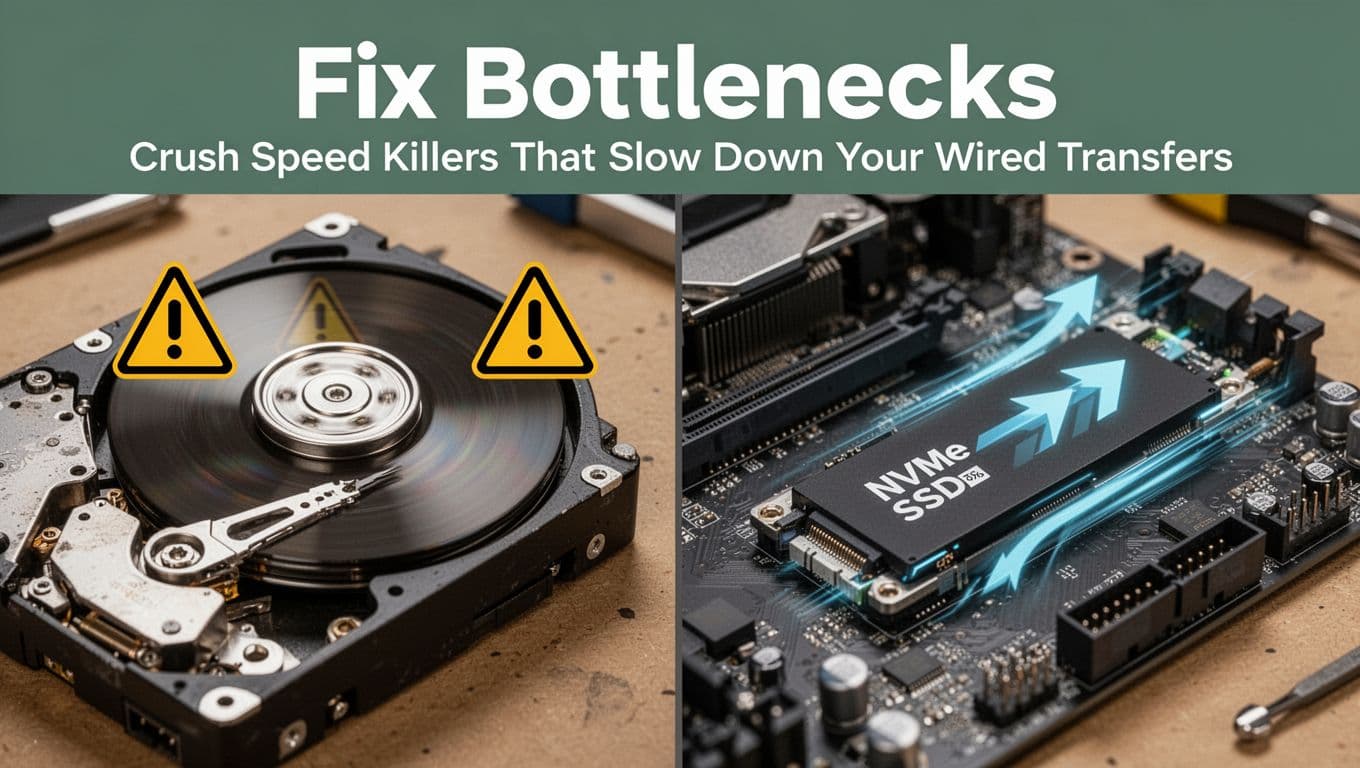
Crush Speed Killers That Slow Down Your Wired Transfers
Even the best port can’t save you from slow storage or bad cabling. Most “wired is slow” cases come from one of a few bottlenecks.
The fastest path is a straight line from source drive to destination drive. Anything that adds friction will show up as a drop in throughput after the initial burst.
Also, keep expectations realistic. If your source is a spinning HDD, you can’t push gigabytes per second through it. You’ll just move data slowly.
The most common wired transfer bottlenecks
Here are the usual suspects:
- HDDs: often cap near 80–200 MB/s
- Cheap or damaged cables: can drop link speed
- Old switches: may not support 10GbE properly end to end
- Antivirus or real-time scanning: can slow file writes
- Overloaded background traffic: other downloads sharing the line
A quick test can confirm storage as the bottleneck. When you run a file copy and see the transfer rate “plateau” low, storage usually causes it.
Swap Slow HDDs for SSDs to Unlock Full Potential
For large transfers, SSDs are the easiest win. NVMe and SATA SSDs can handle sustained reads and writes far above what typical HDDs do.
If you need a check tool, run a benchmark like CrystalDiskMark (or your preferred SSD test utility). Compare your read and write numbers to your observed copy speed.
If your SSD can do hundreds of MB/s, but your transfer sits under 200 MB/s, then something else is wrong. On the other hand, if your SSD test shows 90 MB/s, the SSD is already the problem.
Pick Cables and Ports That Won’t Hold You Back
Cables are where plans go to die. A 10GbE link can fall back to slower modes if wiring or connectors aren’t up to the job.
For 10GbE cabling, aim for Cat6a. For short runs, good Cat6 can work, but Cat6a is safer. Also, avoid adapters that advertise “Ethernet” but do not support 10Gb speeds.
For direct USB4 or Thunderbolt, use cables that explicitly match the standard. When you use the wrong cable category, the device may negotiate down without warning.
Fine-Tune Settings for Non-Stop Wired Performance
You can also reduce interruptions during the transfer:
- Jumbo frames (MTU 9000) can help on 10GbE LANs when the whole path supports it.
- Private or dedicated network prevents other devices from hogging bandwidth.
- Pause heavy background apps, especially cloud sync and backups.
- Check QoS or NIC settings, if you use managed switches.
One simple rule helps a lot: make the transfer network “boring.” Fewer moving parts means steadier throughput.
Follow This Simple Setup to Transfer Files at Top Speed
When you want predictable results, follow a repeatable flow. Don’t guess. Check the link, then test, then scale up.
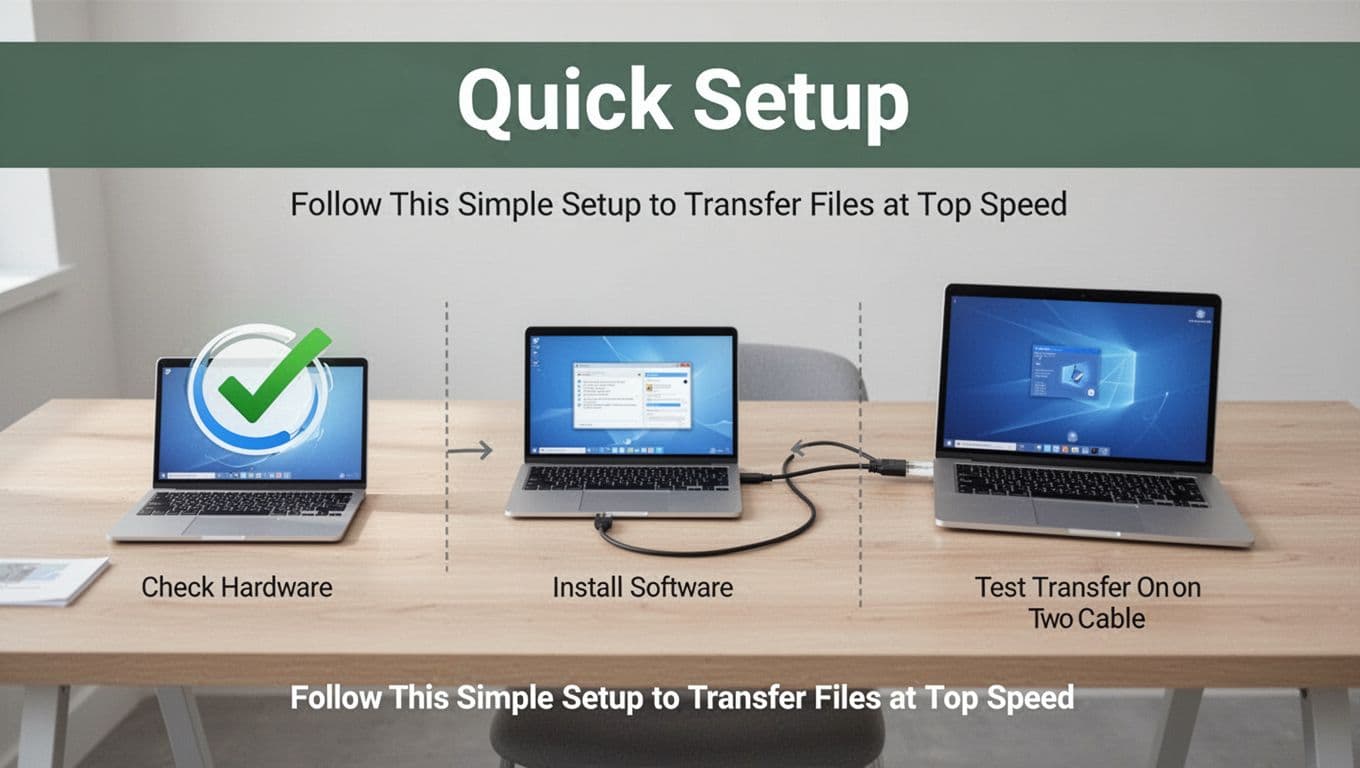
A step-by-step routine you can reuse
- Check hardware first
Confirm ports, confirm the NIC speed, and verify both drives are SSDs when possible. - Pick the right connection
For top raw speed, choose USB4 v2.0 or Thunderbolt 4 direct. For shared backups, choose 10GbE. - Choose a tool that matches the job
Use Aspera FASP or Raysync when speed bursts matter. Use rsync for resuming and syncing, and use SMB3 for everyday LAN shares. - Do one small test
Copy a small folder first. Then look at the transfer rate after a couple minutes. - Move the big file with monitoring
Watch speeds in Task Manager or Activity Monitor. If throughput falls, find the bottleneck and fix it.
Troubleshooting in plain language
If the transfer is slow, don’t start over. Start at the weakest part:
- If speed is under your drive capability, storage is likely capped.
- If link speed is below what you expected, the cable or port negotiated down.
- If speed drops over time, antivirus scanning or background traffic could be slowing writes.
Also, do backups before you experiment. A fast transfer can still waste time if it forces you to redo damaged files.
Conclusion
That slow transfer you hate usually comes from the same few causes: mismatched ports, weak storage, or a protocol that doesn’t push wired bandwidth well. When you use direct USB4 v2.0 or Thunderbolt 4, you can often hit around 2.5–3 GB/s on large files. When you need sharing across PCs, 10GbE with the right setup gets you near 1 GB/s.
The biggest takeaway is simple: the weakest link rules. Upgrade storage first, then use the right cable and a tool that matches your transfer style.
Try one change today. Run a quick test transfer, then share what you saw in the comments. If you want more practical tech tips, subscribe for the next one. Your fast transfers await!